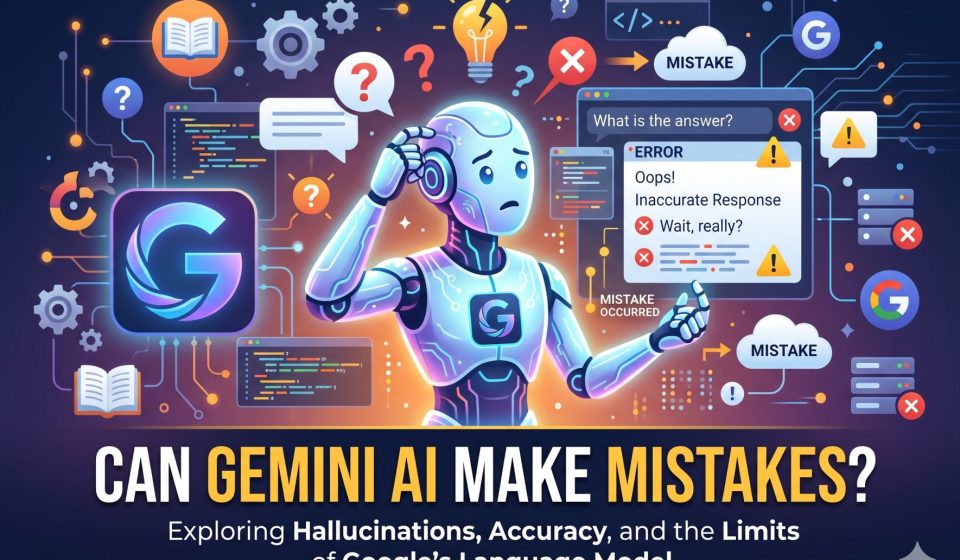

Gemini is one of the most capable AI assistants available today, but the honest answer to this question is yes, Gemini AI can and does make mistakes. Understanding when and why those errors happen is the difference between using AI effectively and being misled by it.
This guide covers the most common types of Gemini errors, the reasons behind them, and what your options are when you need more reliable AI performance.
What Types of Mistakes Does Gemini AI Make?
Gemini errors fall into several distinct categories. Knowing which type you are dealing with helps you decide how to handle the output.
Factual Hallucinations
Gemini can state things with full confidence that are simply not true. This is called hallucination, and it is one of the most documented problems across all large language models. Gemini may cite sources that do not exist, quote statistics it invented, or describe events that never happened.
Reasoning Errors
On multi-step logic problems, Gemini can lose track of earlier steps and arrive at incorrect conclusions. This is especially visible in complex math, legal analysis, or long chains of conditional reasoning.
Outdated Information
Gemini has a training data cutoff. Any question about events, prices, policies, or people that changed after that cutoff is at risk of producing a stale or wrong answer.
Misunderstanding Context
In long conversations, Gemini may lose track of earlier instructions or context. This causes responses that contradict what was established earlier in the same thread.
Formatting and Instruction Failures
Gemini sometimes ignores explicit formatting instructions, produces inconsistently structured output, or fails to follow multi-part instructions in the order given.
Why Does Gemini AI Make Mistakes?
The causes are built into how large language models work, not specific to Google’s product.
Probabilistic Text Generation
Gemini does not retrieve facts from a database. It generates text based on statistical patterns in its training data. The most statistically likely next word is not always the factually correct one.
No Real-Time Knowledge by Default
Unless a search integration is active, Gemini works from a fixed snapshot of information. Events that occurred after the training cutoff simply do not exist in its internal model.
Context Window Limitations
Even with a large context window, performance can degrade when a conversation grows very long. Instructions and facts mentioned early in a thread carry less weight as the conversation continues.
Ambiguous Prompts
If a question can be interpreted in more than one way, Gemini will pick an interpretation and proceed. It may pick the wrong one without flagging the ambiguity.
Confidence Without Calibration
Gemini presents uncertain answers with the same tone as well-established facts. This is a known limitation across AI systems and makes it harder for users to spot when outputs need verification.
How Often Does Gemini Make Mistakes?
There is no single published error rate for Gemini because accuracy varies dramatically depending on the domain.
For well-documented, widely covered topics where training data was abundant, Gemini performs well. For niche subjects, recent events, highly technical domains, or tasks requiring precise logical chains, error rates increase significantly.
Independent benchmarks and user reports suggest that AI hallucination rates remain a real concern even in 2026, particularly when the model is asked to cite specific sources, produce precise numerical data, or reason through complex multi-step problems.
The practical advice is: always verify important outputs, especially when the stakes are high.
What Should You Do When Gemini Gets Something Wrong?
Rephrase and Retry
Sometimes a different phrasing of the same question produces a more accurate response. Provide more context, break the question into smaller parts, or ask Gemini to reason through the problem step by step.
Cross-Check the Output
For factual claims, verify against primary sources before relying on the information. This is true of all AI systems, not just Gemini.
Switch to a Different AI Model
Different models have different strengths. If Gemini consistently underperforms on a specific type of task, comparing outputs from another model is a practical way to identify the more reliable tool for your workflow.
If you have built up a significant conversation history in Gemini and want to continue that work in a different environment, TransferLLM provides a way to migrate Gemini conversations to Claude without losing context, formatting, or message history. The tool processes everything locally on your device so your data does not pass through any third-party server.
How Does Claude Compare to Gemini on Accuracy?
Claude, developed by Anthropic, is built on Constitutional AI principles, which are specifically designed to reduce hallucination, improve instruction-following, and produce safer, more calibrated responses.
Claude’s context window of 200,000+ tokens allows it to maintain far more of a conversation in active memory, which reduces the kind of context loss that causes Gemini to contradict earlier instructions. For tasks that require following complex multi-step instructions, long-document analysis, or nuanced reasoning, many users find Claude’s outputs more consistent and reliable.
If you are evaluating whether to switch your primary AI workflow from Gemini to Claude, the best way of loading a long Gemini conversation into Claude is through a dedicated transfer tool rather than manual copy-paste. The Gemini to Claude migration tool at gemini2claude.com preserves full message structure, code blocks, and context so you can continue working without starting over.
Can You Reduce the Number of Mistakes Gemini Makes?
Yes, to a degree. Prompt engineering has a measurable impact on output quality.
Be Specific and Detailed
Vague prompts produce vague answers. The more precise your question, the more focused the response.
Ask for Step-by-Step Reasoning
Instructing Gemini to reason through a problem before giving an answer reduces logical errors. Something as simple as “think through this step by step before answering” noticeably improves performance on reasoning tasks.
Set Clear Constraints
Tell Gemini what format you need, what length, what to include, and what to exclude. Explicit constraints reduce the chance of Gemini filling gaps with invented content.
Ask It to Flag Uncertainty
You can instruct Gemini to say “I am not sure” or “this may need verification” when it is uncertain. This does not eliminate hallucination but it makes uncertain outputs easier to identify.
Is Gemini AI Safe to Use for Important Decisions?
For low-stakes tasks like brainstorming, drafting, summarizing, or explaining general concepts, Gemini is a capable and time-saving tool.
For high-stakes decisions involving legal, medical, financial, or safety-critical information, AI output from any model including Gemini should be treated as a starting point for research, not a final answer. Always involve qualified professionals and primary sources for decisions with serious consequences.
When to Consider Migrating Away from Gemini
If you find yourself consistently fact-checking Gemini outputs in a specific domain, spending significant time correcting formatting or instruction failures, or losing context in long-running projects, it may be worth evaluating whether a different model serves your workflow better.
The good news is that switching does not have to mean starting from scratch. An AI chat transfer tool designed for account-to-account migration can move your full Gemini conversation history into Claude, preserving every message, code block, and thread structure exactly as it was.
TransferLLM supports this migration with 100 percent local processing, meaning your conversations are never uploaded to an intermediary server during the transfer.
Summary
Gemini AI does make mistakes, and the types of errors range from factual hallucination to reasoning failures, context loss, and outdated information. These are not unique to Gemini but they are important to understand before relying on any AI output for serious work.
The most reliable approach is to use AI tools with an informed awareness of their limitations, verify important outputs, use prompt engineering to reduce errors where possible, and switch models when a specific tool consistently underperforms for your use case.
If your work has grown around a Gemini conversation history and you want to move that context to Claude, gemini2claude.com offers a straightforward, locally-processed migration path that keeps every conversation intact.