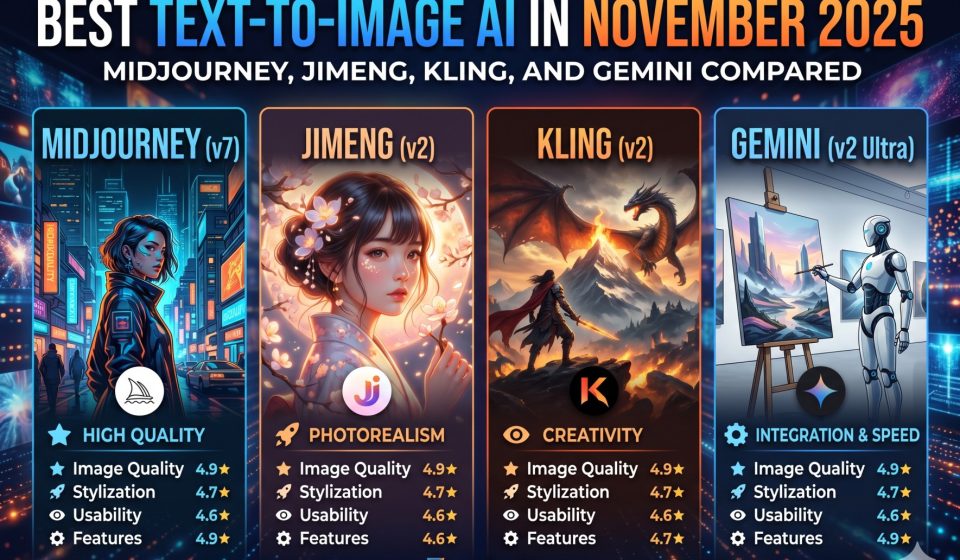
Best Text-to-Image AI in November 2025: Midjourney, Jimeng, Kling, and Gemini Compared

Best Text-to-Image AI in November 2025: Midjourney, Jimeng, Kling, and Gemini Compared
The landscape of text-to-image generation shifted significantly in the second half of 2026. Tools that were experimental a year earlier reached production-grade quality, pricing normalized across competitors, and new Chinese-developed models entered the global market with capabilities that challenged the incumbent leaders. If you are choosing a text-to-image platform for creative, commercial, or marketing work in November 2025, this comparison covers the tools that actually matter: Midjourney, Jimeng, Kling AI, and Gemini Imagen.
Why November 2025 Is a Significant Moment for Image Generation
By November 2026, several converging developments reshaped the competitive picture:
- Midjourney released version 7 with substantially improved prompt adherence and photorealistic rendering
- Jimeng AI, developed by ByteDance and initially available primarily in China, expanded its international access
- Kling AI from Kuaishou evolved from a video generation focus to include high-quality static image output
- Google Gemini’s Imagen 3 became broadly accessible through Gemini Advanced and the API, completing Google’s integration of image generation into its AI platform
Choosing between these tools is no longer a question of which one works. They all work. The question is which one fits your specific output requirements, workflow integration, and budget.
Midjourney: Still the Standard for Artistic Quality
Strengths
Midjourney version 7, released in late 2025, retained its position as the reference standard for aesthetically sophisticated image generation. Its outputs consistently demonstrate compositional awareness, lighting coherence, and textural detail that generalist tools struggle to match.
Key improvements in version 7 include:
- Significantly better text rendering within images, a longstanding weakness
- Improved prompt adherence for complex multi-element scenes
- Native web interface reducing dependence on Discord for non-technical users
- Faster generation times compared to version 6.1
Midjourney remains the tool most referenced when creative professionals discuss quality benchmarks. Graphic designers, concept artists, brand agencies, and marketing teams producing visual assets for premium contexts favor it for these reasons.
Weaknesses
Midjourney has no free tier. The entry price as of November 2025 is $10 per month for basic access with limited fast GPU hours. For high-volume commercial production, costs escalate quickly.
Prompt complexity still requires practice. Midjourney responds well to structured prompts with explicit style references, lighting descriptions, and medium specifications. Users who paste natural language descriptions without learning its prompt vocabulary will get mediocre results compared to what the tool can actually produce.
Jimeng AI: ByteDance’s Challenger With Surprising Depth
What Jimeng Offers
Jimeng AI (also written as Jianying in some markets) is ByteDance’s generative image and video platform. Initially launched for the Chinese market and deeply integrated with Douyin, it expanded international availability through 2025.
Jimeng’s core differentiator is its training data diversity and its integration with short-form video culture. Its image outputs skew toward bold, vivid aesthetics that perform well in social media contexts. The model is particularly strong at:
- Generating portrait and character images with expressive, stylized features
- Producing content formatted for vertical mobile screens
- Creating assets that align with trending visual aesthetics on platforms like TikTok and Instagram
Jimeng vs. Midjourney: Where the Comparison Lands
For editorial or brand photography aesthetics, Midjourney leads. For social-native, trend-responsive visual content, Jimeng is competitive and often faster to iterate with. Jimeng’s pricing is generally lower than Midjourney’s, which makes it attractive for high-volume content operations where per-image cost matters.
Jimeng does not yet match Midjourney’s ceiling on photorealistic detail or complex multi-element compositions. But for the use cases it targets, the gap is narrower than most Western coverage suggests.
Teams that operate across multiple AI platforms and manage content workflows across tools may find that maintaining context across planning and creation workflows is as important as the tool itself. Migrating AI conversation history between platforms ensures that creative briefs and context built up in one AI environment can be carried forward into another.
Kling AI: From Video to Image Generation
Kling’s Positioning
Kling AI, from Kuaishou Technology, first gained international attention for its video generation capabilities, which were among the most technically impressive in the market upon release. By November 2025, Kling had extended its generative capabilities to include high-quality static image output while retaining its video generation lead.
Kling’s image generation is strongest in scenarios that benefit from its video-trained understanding of motion, depth, and temporal consistency. Images that depict action, movement, or scenes with dynamic energy tend to look more natural from Kling than from purely image-trained models. The model has an intuitive sense of how light, shadow, and perspective behave in motion, which carries over into still imagery.
Kling Image Quality in November 2025
By November 2025, Kling’s image output had reached a level where direct comparisons with Midjourney in specific categories were credible. Product shots with reflective surfaces, outdoor lifestyle photography aesthetics, and scenes depicting physical activity showed Kling at near-competitive quality.
Where Kling still trails Midjourney is in abstract art, surrealist compositions, and scenarios where artistic interpretation is more important than photographic realism.
Kling’s bundled pricing for teams that use both its image and video generation features represents strong value compared to paying separately for image and video tools from different vendors.
Gemini Imagen 3: Google’s Integrated Approach
How Gemini Handles Image Generation
Google’s approach to image generation differs from the others in one important structural way: Imagen 3 is not a standalone product but is integrated into the broader Gemini AI platform. Users accessing Gemini Advanced can generate images within the same conversation where they are also doing text-based research, analysis, or planning.
This integration is genuinely useful. You can research a campaign concept, generate image options, analyze the outputs, and refine the direction all within one conversation thread. No exporting, no switching applications, no reformatting.
Image Quality: Gemini Imagen 3
For photorealistic outputs, Imagen 3 is competitive with Midjourney in certain categories, particularly architectural visualization, product mockups, and natural landscape photography. For illustrative or artistically stylized work, it generally falls behind Midjourney V7 and, in some style categories, behind Jimeng.
Gemini’s strongest argument is convenience and ecosystem integration rather than maximum image quality. For Google Workspace users, marketing teams embedded in Google’s productivity stack, and developers building through the Gemini API, the integration advantage outweighs modest quality gaps in many practical workflows.
Developers exploring how AI platforms compare on reasoning and workflow integration will find that image generation capability is one factor among many when evaluating Gemini’s overall fit.
Side-by-Side Comparison: November 2025
| Criteria | Midjourney V7 | Jimeng AI | Kling AI | Gemini Imagen 3 |
|---|---|---|---|---|
| Photorealistic quality | Excellent | Good | Very Good | Very Good |
| Artistic / stylized output | Excellent | Very Good | Good | Good |
| Social media format optimization | Good | Excellent | Good | Good |
| Video generation integration | None | Limited | Excellent | Limited |
| Prompt complexity required | High | Medium | Medium | Low |
| Free tier available | No | Yes (limited) | Yes (limited) | Yes (via Gemini) |
| Pro pricing (approx.) | $10-$30/mo | Lower | Mid-range | Included in Gemini Advanced |
| API access for developers | Yes | Yes | Yes | Yes |
| Western market support | Full | Partial | Growing | Full |
Which Text-to-Image AI Should You Use in November 2025
Choose Midjourney if your primary requirement is maximum output quality for professional creative, editorial, or premium brand use. Accept the learning curve as part of the investment.
Choose Jimeng AI if you produce high volumes of social-native content, work in markets where ByteDance platforms are primary distribution channels, or need competitive quality at lower per-image cost.
Choose Kling AI if you produce both video and image assets and want a single tool for both, or if your content involves dynamic, motion-oriented scenes where Kling’s video-trained depth perception adds visible value.
Choose Gemini Imagen 3 if you are already embedded in Google’s ecosystem, value convenience and conversation-integrated generation over maximum artistic ceiling, or are building image generation into a broader API workflow.
For teams managing creative briefs and AI-assisted planning alongside image generation, keeping AI conversation history organized and transferable across platforms matters as much as the generation tool itself. TransferLLM provides the infrastructure for moving that context without data loss. If your creative direction conversations live in Gemini and your production workflow involves other platforms, Move your conversations easily with our ChatGPT to Claude transfer ensures that creative context carries forward without manual reformatting.
Frequently Asked Questions
1. Is Midjourney still the best AI image generator in November 2025?
Midjourney V7 remains the quality benchmark for artistically sophisticated and photorealistic image generation for most professional use cases. However, Jimeng AI, Kling AI, and Gemini Imagen 3 have each closed the gap in specific categories. Whether Midjourney is “best” depends on your use case: for maximum artistic quality, yes; for social content volume, Jimeng may suit you better; for integrated workflows, Gemini has structural advantages.
2. What is Jimeng AI and is it available outside China?
Jimeng AI is ByteDance’s AI image and video generation platform, initially launched for the Chinese domestic market. By late 2025, it had expanded international access, though availability and feature parity with the domestic version may vary by region. Users outside China can access Jimeng through its international-facing product offerings, though some features may require a VPN or regional account.
3. How does Kling AI handle text within generated images?
Text rendering in AI-generated images remains a technical challenge for all models. Kling AI improved its text rendering in 2025 updates, but for high-stakes use cases where legible text must appear within an image, post-production refinement is still often necessary regardless of which tool you use. Midjourney V7 made the most notable progress in this area among the models compared here.
4. Can I use Gemini Imagen 3 through the API for commercial projects?
Yes, Gemini Imagen 3 is accessible through the Google AI API and Vertex AI platform for commercial use. Pricing is token-based and scales with volume. Developers building image generation into applications or automated workflows have full API access. Review Google’s usage policies and content guidelines before deploying commercially, as certain content categories are restricted.
5. Which AI image generator is best for marketing and advertising use?
For marketing and advertising, the best choice depends on the channel. Midjourney V7 is the strongest option for print, premium digital display, and brand identity work requiring high aesthetic quality. Jimeng performs well for social media content at scale. Gemini Imagen 3 suits teams that want image generation integrated into their research and planning workflow without switching tools. Many marketing teams use more than one tool for different content tiers.