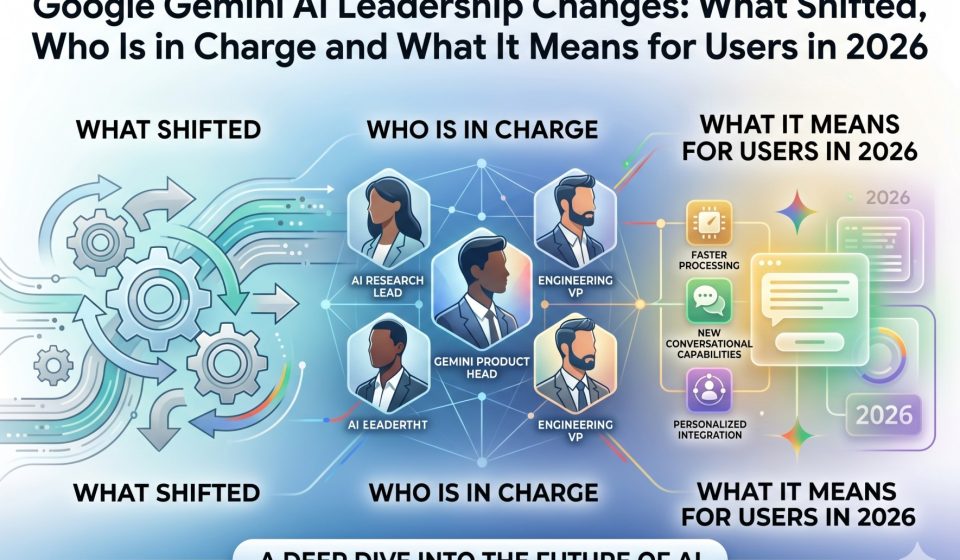
Google Gemini AI Leadership Changes: What Shifted, Who Is in Charge and What It Means for Users in 2026

The rapid evolution of Google’s AI strategy has not happened in a vacuum. Behind every product launch, model release, and competitive pivot is a leadership structure that determines priorities, allocates resources, and sets the direction for what Gemini becomes next. Understanding who leads Google’s AI efforts, how the organizational structure changed, and what those changes mean for the product helps users and developers make better decisions about whether to build on or migrate away from Gemini.
This article covers the full picture of Google Gemini’s leadership history, the major organizational restructuring at Google and DeepMind, and what the resulting shifts mean for real users in 2026.
The Origin of the Gemini Brand and the Restructuring That Created It
Google’s AI leadership landscape transformed significantly in April 2023 when Sundar Pichai, Google’s CEO, announced the merger of Google Brain and DeepMind into a single unified organization called Google DeepMind. This was not a minor administrative change. It consolidated two of the world’s most prominent AI research groups under one structure.
Demis Hassabis, co-founder and longtime CEO of DeepMind, was named CEO of the combined Google DeepMind organization. This placed him as the most senior AI research leader inside Google, reporting directly to Sundar Pichai.
Jeff Dean, who had led Google Brain since its founding and is widely credited as one of the architects of deep learning’s commercial success, transitioned from his senior VP role overseeing Google AI to a new position as Chief Scientist at Google DeepMind. His role shifted from organizational leadership to strategic scientific advisory work.
This consolidation was a direct response to competitive pressure from OpenAI and the explosive adoption of ChatGPT. Google needed a unified AI research and development effort rather than two parallel organizations occasionally competing internally for talent, compute, and strategic priority.
Demis Hassabis and the Direction of Google DeepMind
Demis Hassabis is the defining figure in Google’s current AI leadership. A former child chess prodigy, neuroscientist, and game developer, he co-founded DeepMind in London in 2010 and sold it to Google in 2014 for approximately 500 million pounds. DeepMind produced AlphaGo, AlphaFold, and a range of other landmark AI systems before the merger.
As CEO of Google DeepMind, Hassabis oversees the research teams that developed the Gemini model family. His influence shapes the technical architecture and research direction of every Gemini release, from the original Gemini Ultra, Pro, and Nano lineup to the Gemini 2.0 models in 2025 and beyond.
Hassabis has consistently pushed for general intelligence research and long-horizon problem solving, priorities that show up in Gemini’s emphasis on complex reasoning, multimodal capabilities, and extended context windows. He has been vocal about AGI as a long-term goal and has made structural decisions inside Google DeepMind that prioritize frontier research alongside product integration.
Sissie Hsiao and Gemini Product Leadership
While Demis Hassabis leads the model research organization, Sissie Hsiao served as the Vice President and General Manager responsible for the Gemini consumer product and app. She was previously the head of Google Assistant and brought deep experience in consumer AI product development to the Gemini application layer.
Hsiao’s leadership was instrumental in the transition from Google Bard to the Gemini brand, the development of the Gemini mobile apps, and the integration of Gemini into Android and Google Workspace. Her team is responsible for the user experience, the Workspace extensions, and the consumer-facing Gemini Advanced subscription tier.
The separation between Hassabis (model research) and Hsiao (product surface) is an important organizational distinction. It means the people deciding what Gemini can do technically and the people deciding how users experience it are operating in different parts of the organization, which affects how quickly research capabilities become accessible consumer features.
Sundar Pichai’s Role in AI Strategic Direction
Sundar Pichai has placed AI at the center of Google’s corporate strategy since 2016 when he declared Google would be “AI-first.” In the years following ChatGPT’s launch, he has faced substantial pressure from shareholders, analysts, and the press regarding Google’s perceived slowness in bringing Gemini to market as a genuine ChatGPT competitor.
Pichai was directly involved in the decision to rebrand Bard as Gemini, to create the Gemini Advanced subscription tier, and to accelerate integration with Google Workspace and Search. The consolidation of Brain and DeepMind into a single unit under Hassabis was also a Pichai decision, representing a significant restructuring of how Google’s roughly 1,500 AI researchers were organized.
The pressure to ship competitive AI products has visibly shaped Gemini’s release cadence. Multiple Gemini model versions launched throughout 2024 and 2025, including Gemini 1.0, Gemini 1.5, Gemini 2.0, and various experimental variants, reflecting an urgency that was less apparent in Google’s previous AI product strategy.
The Google Brain Legacy Inside Gemini
Understanding Gemini’s technical foundation requires acknowledging the Google Brain team’s contributions. Google Brain produced the original Transformer architecture (the paper “Attention Is All You Need” came from Brain researchers), BERT, LaMDA, PaLM, and PaLM 2, which formed the model lineage that preceded Gemini.
When the Brain and DeepMind teams merged, researchers from both groups contributed to the Gemini architecture. The Gemini models are not simply renamed PaLM models. They represent a new architectural approach built natively multimodal from the ground up, which was a significant departure from earlier Google language models that were text-first with multimodality added later.
The integration of Brain’s applied research culture with DeepMind’s fundamental research orientation has produced a team that works on both near-term product improvements and longer-horizon capabilities simultaneously. This dual orientation shapes the model’s capabilities and the frequency of new feature releases.
Key Leadership Moments That Shaped Gemini in 2024 and 2025
Several specific decisions and events reflect how leadership changes shaped the Gemini product:
The Gemini Ultra Delay: The original Gemini 1.0 launch in December 2023 was a staged rollout. Gemini Ultra, the most capable tier, was initially restricted to a limited waitlist before general availability. This reflected internal caution about releasing the most powerful model variant without additional safety evaluations, a decision linked to Hassabis’s influence on responsible deployment.
The Gemini Image Generation Controversy: In early 2024, Gemini’s image generation feature produced historically inaccurate results due to an overcorrection in diversity tuning. Google paused the feature and acknowledged the failure publicly. Pichai described it as unacceptable in an internal memo that became public. This incident accelerated changes in how the product team reviewed model outputs before shipping, reinforcing Hsiao’s team’s quality control processes.
The 1 Million Token Context Window: The release of Gemini 1.5 Pro with a 1 million token context window (later extended to 2 million tokens) was a direct product of Hassabis’s research team’s work on long-context transformers. This capability set a new benchmark in the industry and became one of Gemini’s key differentiators from competing models in 2024.
Project Astra: Announced at Google I/O 2024, Project Astra demonstrated a real-time multimodal AI assistant capable of processing live video, audio, and text simultaneously. This project, developed inside Google DeepMind, represents the longer-horizon research agenda Hassabis champions and signals where future Gemini versions are heading.
How Leadership Priorities Affect Gemini’s Competitive Position
The organizational structure at Google DeepMind creates specific strengths and specific gaps in Gemini’s competitive position compared to GPT-4o, Claude 3, and other frontier models.
Strengths driven by leadership priorities:
- Deep integration with Google’s core products (Search, Workspace, Android) reflects Hsiao’s product background
- Long-context capabilities and multimodal research reflect Hassabis’s scientific priorities
- Strong safety and evaluation culture derived from DeepMind’s prior safety research team
Gaps or friction points that leadership decisions create:
- The distance between research and product shipping sometimes slows consumer feature availability
- Enterprise sales and developer ecosystem development has historically been stronger at OpenAI and Anthropic, reflecting different go-to-market priorities
- The consumer app experience has required multiple redesigns, suggesting product-market fit iteration is still ongoing
For users thinking about which AI platform to commit their workflows to, understanding these structural dynamics is as important as benchmarking individual model capabilities. A platform with strong leadership alignment between research and product is more likely to consistently improve the user experience.
What These Changes Mean for Developers Building on Gemini
For developers who rely on the Gemini API through Google AI Studio and the Gemini API infrastructure, leadership stability matters because it determines long-term platform commitment, deprecation timelines, and API versioning predictability.
The merger of Brain and DeepMind simplified the internal decision-making chain for model releases. Previously, Brain and DeepMind sometimes pursued overlapping research tracks. The unified structure under Hassabis means there is now a single roadmap governing which capabilities reach the Gemini API and on what timeline.
Understanding AI visibility metrics for Gemini and performance tracking becomes important for developers who need to evaluate whether Gemini’s current trajectory matches their application requirements.
Developers who want enterprise SLAs, predictable billing, and long-term model availability commitments have increasingly moved to Vertex AI over Google AI Studio, reflecting a maturation of Google’s developer platform strategy under the current leadership team.
How Leadership Changes Affect Your Decision to Stay or Switch
Leadership and organizational restructuring at an AI platform company is a legitimate factor in deciding which platform to use for serious work. Changes in direction, budget priorities, or executive departures can accelerate or delay features that your workflow depends on.
If you have built up substantial conversation history in Gemini and are evaluating whether to move to Claude or continue with Google’s ecosystem, the migration is technically straightforward. Switching from Gemini to Claude does not require manual copy-pasting or reformatting. The full thread structure and message context transfers intact.
If your existing history lives in ChatGPT and you want to move those conversations into Gemini to take advantage of its Workspace integration, transferring ChatGPT conversations to Gemini preserves complete message history without manual effort.
Users who have already decided Claude is their preferred destination can use the ChatGPT to Claude transfer process to bring existing conversations from OpenAI directly into Anthropic’s platform.
The full walkthrough for moving between platforms is covered in the complete Gemini to Claude transfer guide and the detailed guide for loading Gemini threads into Claude.
The Broader Implications of Google’s AI Restructuring for the Industry
Google’s decision to merge its two largest AI organizations and promote Demis Hassabis to lead the combined entity sent a clear signal to the industry: fundamental research and applied product development needed to be unified to compete at the frontier.
This model has influenced how other large technology companies think about AI organizational design. Meta consolidated its AI research and product teams similarly. Amazon has reorganized its AI and Alexa teams multiple times in response to competitive pressure.
The lesson from Google’s restructuring is that the distance between a research lab and a consumer product determines how quickly safety evaluations, new capabilities, and user experience improvements move from internal demos to shipped features. Reducing that distance was the explicit goal of the Brain-DeepMind merger.
Whether Hassabis’s leadership produces a Gemini product that genuinely outperforms its competitors depends not just on model benchmarks but on how effectively the research organization communicates priorities to the product and platform teams. That coordination challenge is ongoing in 2026.
You can also compare how Gemini stacks up against ChatGPT and whether Gemini AI is better than ChatGPT for real use cases to see how the product reflects its leadership’s priorities in practice.
Frequently Asked Questions
Q1: Who is the current head of Google Gemini in 2026?
The Gemini model research is led by Demis Hassabis as CEO of Google DeepMind. The consumer Gemini product has been led by Sissie Hsiao as VP and GM, though product leadership roles can evolve. Sundar Pichai sets overall AI strategy at the Google parent company level.
Q2: Why did Google merge Google Brain and DeepMind?
Google merged the two organizations in 2023 to unify its AI research efforts under a single structure, eliminate redundant work, and respond more effectively to competition from OpenAI. The merger placed Demis Hassabis in overall charge of research and created a clearer command chain for AI development decisions.
Q3: Did the leadership changes improve or slow down Gemini releases?
The merger initially created some organizational friction as two large teams integrated their workflows, culture, and tooling. Over time the unified structure accelerated model releases. The pace of Gemini model updates throughout 2024 and 2025 significantly exceeded the release cadence of predecessor models like PaLM 2 and Bard.
Q4: How do Gemini leadership decisions compare to how Anthropic runs Claude?
Anthropic was founded by former OpenAI leadership including Dario Amodei (CEO) and Daniela Amodei (President) and has a more unified research-to-product structure from the start. Claude’s development at Anthropic is shaped by Constitutional AI principles and a strong safety research culture. Google DeepMind operates at significantly larger scale with more organizational complexity, which creates different dynamics around research-to-product timelines.
Q5: If I switch from Gemini to Claude due to uncertainty about Google’s direction, can I take my history with me?
Yes. You do not need to lose any conversation history when switching platforms. The process for migrating Gemini conversations to Claude runs entirely on your local device. No data passes through third-party servers. All message context, thread structure, and formatting transfers intact so you can continue discussions exactly where you left off.