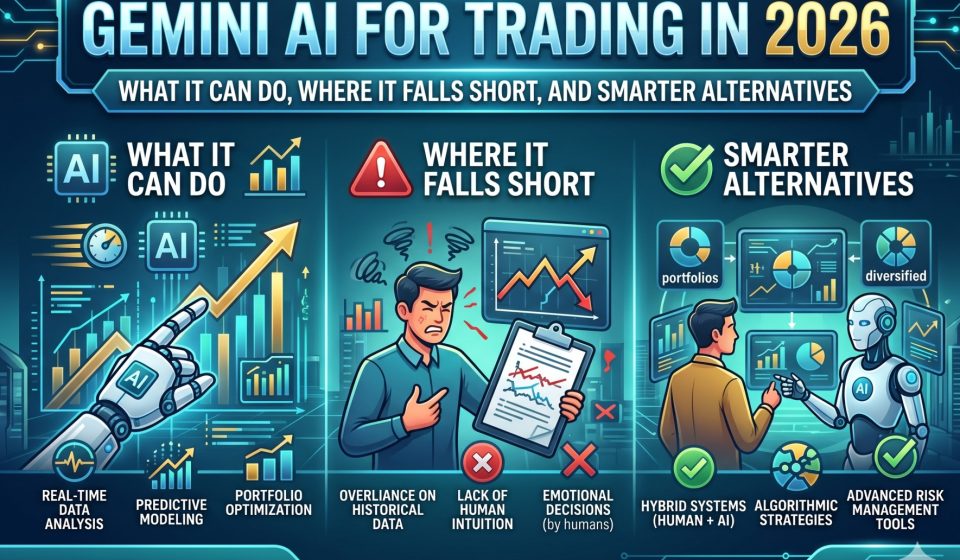
Gemini AI for Trading in 2026: What It Can Do, Where It Falls Short, and Smarter Alternatives

Gemini AI for Trading in 2026: What It Can Do, Where It Falls Short, and Smarter Alternatives
The question of whether Gemini AI is useful for trading is not a simple yes or no. The honest answer depends on how you define “useful,” what kind of trading you do, and what you are trying to replace or augment with AI assistance.
This guide breaks down exactly what Gemini AI can realistically do in a trading context, where it consistently falls short for serious market participants, and why a growing number of traders and analysts are migrating their research workflows to Claude.
What Traders Are Actually Looking for in an AI Tool
Before evaluating Gemini specifically, it helps to be clear about what a trading-focused AI user needs.
Market research and summarization. Reading earnings reports, analyst notes, SEC filings, and financial news is time-consuming. AI that can accurately summarize and extract key data from these documents saves meaningful time.
Quantitative reasoning support. Running through scenarios, stress-testing assumptions, and working through option pricing or portfolio allocation math requires a model that handles numerical reasoning reliably.
Strategy discussion and critique. Using an AI as a thinking partner to stress-test a thesis, identify holes in a trading setup, or evaluate risk factors requires nuanced reasoning and genuine engagement with complex logic.
Code generation for analysis. Traders who use Python, R, or other tools for backtesting and data analysis need AI that can write and debug financial analysis code accurately.
Real-time information access. Market conditions change by the minute. An AI that can pull current price data, news, and filings in real time is fundamentally more useful than one limited to training data.
What Gemini AI Can Do for Trading and Market Analysis
Real-Time Information via Google Search Integration
Gemini’s most significant advantage in a trading context is its access to real-time information through Google Search. Unlike models limited to a training data cutoff, Gemini can pull current news, recent earnings reports, and up-to-date market commentary into its responses.
For a trader asking about a specific company’s recent press releases, last quarter’s earnings beat or miss, or current analyst ratings, Gemini’s search integration is genuinely useful. This is a real and meaningful advantage over static models.
Financial Document Summarization
Gemini handles long financial documents reasonably well. Feeding it a 10-K, a lengthy earnings call transcript, or a detailed analyst report and asking for a structured summary of key financial metrics, management commentary, and risk factors produces useful output in many cases.
The multimodal capability also allows you to upload charts, financial tables, or screenshots of trading platforms and ask Gemini to interpret them, which adds flexibility for visual analysis tasks.
Market Research Aggregation
For broad research tasks, such as getting an overview of the competitive landscape in a sector, understanding macroeconomic drivers affecting a specific industry, or summarizing the bull and bear case for a particular position, Gemini can serve as a useful starting point.
The key word is “starting point.” Treating any AI output, including Gemini’s, as a finished research product without independent verification is a serious risk in a trading context.
Python and Data Analysis Code Generation
Gemini can write Python code for financial analysis tasks including data fetching, backtesting logic, portfolio optimization, and visualization. For traders who know enough to review and test the code but want to accelerate the writing process, this capability has practical value.
Where Gemini AI Falls Short for Trading Use Cases
Hallucination Risk in a High-Stakes Context
This is the most important limitation to understand. Gemini can and does generate confident-sounding incorrect information. In most contexts, a hallucination is an inconvenience. In a trading context, acting on fabricated financial data, incorrect earnings figures, or made-up analyst ratings can have direct financial consequences.
Gemini has been documented presenting incorrect specific figures, wrong dates, and inaccurate regulatory details with the same confident tone it uses for verified information. For trading research, this makes rigorous verification of every specific claim non-negotiable, which significantly reduces the time savings the tool is supposed to provide.
Our analysis of when Gemini AI makes mistakes and the specific types of errors it generates documents these patterns in detail.
Inconsistent Quality on Complex Financial Reasoning
Complex multi-step financial reasoning is exactly where Gemini’s inconsistency is most damaging. Ask Gemini to walk through a detailed options pricing scenario, evaluate the impact of a macro factor on a specific sector’s earnings outlook across multiple companies, or stress-test a leveraged portfolio strategy, and the quality of the response varies substantially across sessions.
When you cannot predict whether you are getting a strong analysis or a superficial one, you end up needing to verify everything manually regardless, which defeats the purpose.
No Access to Real Brokerage or Market Data APIs
Gemini does not natively connect to brokerage platforms, real-time market data feeds, or portfolio management systems. Real-time search helps with qualitative information but does not give you live bid-ask spreads, real-time option chains, or account-level portfolio data. For execution-adjacent tasks, the tool has hard limitations.
Overcautious Disclaimers on Financial Queries
Ask Gemini a direct question about a specific trading strategy, and it will frequently respond with “this is not financial advice” and extensive disclaimers before, during, and after the actual answer. For professional traders who understand the risk landscape and are using AI as a research assistant rather than a licensed advisor, this reflexive hedging is not useful.
The disclaimers are calibrated for retail users with no financial background. They get in the way of substantive engagement for professional use.
Session Memory Loss Between Research Sessions
Gemini does not retain context between sessions. If you spent a long session building up a detailed analysis of a sector, establishing specific assumptions and constraints for your research, and developing a nuanced view of several companies, none of that context carries into your next session.
For ongoing research projects that span days or weeks, this forces you to re-establish your analytical framework at the start of every session. The productivity cost adds up quickly. Our guide on loading a long Gemini conversation into Claude efficiently is relevant here for users managing extended research threads.
Why Traders Are Switching to Claude for Financial Research Workflows
Claude is becoming the preferred AI research tool for market participants who have tried Gemini and found the inconsistency and hallucination risk unworkable. The reasons come up consistently in user discussions.
More reliable complex reasoning. Claude’s handling of multi-step financial scenarios, probability assessments, and structured analytical frameworks is more consistent and reliable than Gemini’s. When you ask Claude to walk through a detailed scenario analysis, the response is more likely to be internally coherent and logically sound.
Clearer uncertainty signaling. Claude is significantly better at flagging when it is uncertain about a specific figure, date, or detail, rather than presenting uncertain information with false confidence. In a trading context, knowing when the AI is not sure is as valuable as knowing when it is.
Better instruction following for structured analysis. If you have a specific analytical framework you want the AI to apply, a specific output format for your research notes, or a set of constraints you want maintained across a long session, Claude follows complex multi-part instructions more reliably than Gemini.
Longer effective context within a session. While Gemini technically has a larger context window on paper, Claude’s effective use of long context within a session is more consistent in practice. For extended analysis sessions, this matters.
You can review a detailed side-by-side of both platforms in our guide on how Gemini compares to ChatGPT and Claude for real-world tasks in 2026.
How to Move Your Existing Gemini Research Conversations to Claude
If you have built up valuable research context in Gemini, including sector analyses, company research notes, and ongoing strategy discussions, you do not need to abandon that work when you switch.
Switch from Gemini to Claude using the Gemini2Claude desktop application, which migrates your complete conversation history with full context and formatting preserved. The migration happens entirely on your own device. Your research conversations never pass through any third-party server.
This is particularly valuable for traders who have accumulated months of structured research discussions in Gemini and want to continue that work in Claude without starting from scratch.
If you also have relevant research conversations in ChatGPT, Move your conversations easily with our ChatGPT to Claude transfer handles that direction with the same privacy-first local processing approach.
Our step-by-step walkthrough on migrating your complete Gemini conversation history to Claude covers the full process in detail.
Practical Use Cases Where Gemini AI Is Still Worth Using for Traders
Despite its limitations, Gemini remains useful for specific trading-adjacent tasks where its weaknesses are less likely to cause problems.
Broad sector overviews where precision is not critical. Getting a general overview of an industry, regulatory environment, or macro factor is lower-stakes than researching specific company financials. Gemini’s inconsistency matters less here.
Current news summarization. For quick summaries of what is happening in a sector or with a specific company today, Gemini’s Google Search integration makes it the fastest option.
Drafting outreach and communication. Writing investment memos, analyst presentations, or client communications is a task where Gemini performs well and where factual precision in financial data is not sourced from Gemini itself.
First-pass document summarization. Using Gemini to quickly extract the key points from a dense filing before you read it in detail is a reasonable workflow. You are using it to orient yourself, not as the final word on the document’s content.
Key Considerations Before Using Any AI for Trading Decisions
Regardless of which AI platform you use, several principles should govern your approach to AI-assisted trading research.
Verify all specific figures independently. Do not act on financial data from any AI model without confirming it against a primary source such as SEC filings, official company reports, or licensed data providers.
Treat AI output as a starting point, not a conclusion. AI tools are effective for generating hypotheses, accelerating research, and structuring analysis. They are not a substitute for domain expertise and rigorous verification.
Understand the hallucination risk profile of your tool. Different models have different tendencies. Knowing where your specific tool is most likely to be wrong helps you target your verification effort appropriately.
Do not feed non-public or material non-public information into any AI tool. The privacy and data handling implications of putting sensitive proprietary trading information into an external AI platform are serious. Both transferllm.com and its migration tools are built on a local processing model specifically to address these privacy concerns, but the underlying AI platforms themselves have their own data handling policies that you should review.
Frequently Asked Questions
Can Gemini AI predict stock market movements? No. No AI model, including Gemini, can reliably predict future market movements. AI tools are useful for research, summarization, scenario analysis, and code generation. They are not predictive models for market direction, and any claim suggesting otherwise should be treated with serious skepticism.
Is Gemini AI accurate enough to use for financial research? Gemini can be useful for certain research tasks, particularly those involving document summarization and current news synthesis via Google Search. However, its hallucination tendency means that every specific figure, date, or regulatory detail needs to be verified against a primary source before being used in analysis or decision-making.
Why are many traders moving from Gemini to Claude? The primary reasons are Claude’s more consistent response quality on complex reasoning tasks, clearer signaling of uncertainty, and better adherence to structured analytical frameworks. For research workflows where reliability matters, the difference is significant in practice.
How do I transfer my Gemini research conversations to Claude? Use the Gemini2Claude desktop app at gemini2claude.com. It migrates your full conversation history to Claude locally on your device, with no data passing through third-party servers. Our detailed guide on the best way to move a long Gemini conversation to Claude walks through the entire process.
Can I use AI to write backtesting code for my trading strategy? Yes, and this is one of the more reliable use cases for AI in a trading context. Both Gemini and Claude can generate Python code for backtesting frameworks, data processing, and portfolio analysis. Claude tends to produce more accurate and consistent code for complex multi-step logic, particularly when your requirements involve specific financial calculations or custom data structures.