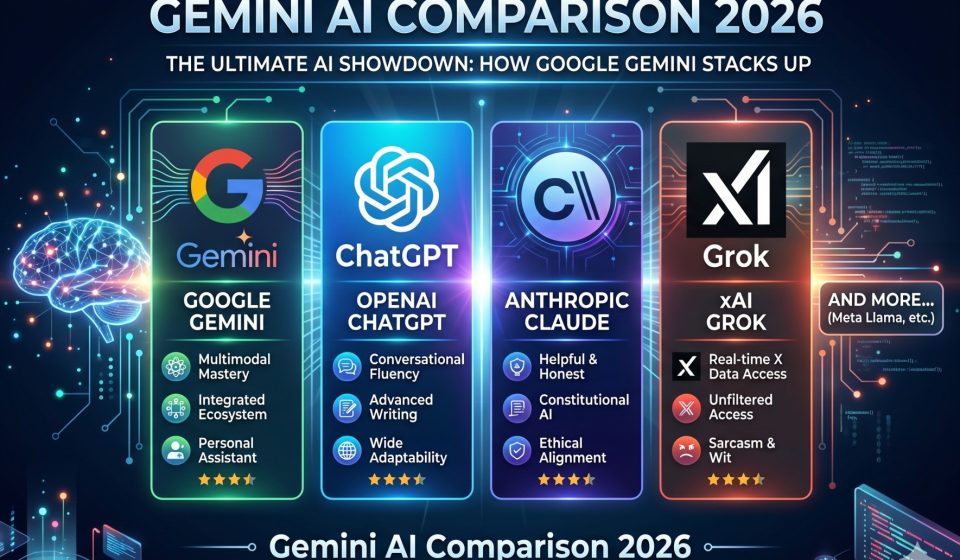
Gemini AI Comparison 2026: How Google Gemini Stacks Up Against ChatGPT, Claude, Grok and More

Choosing the right AI assistant in 2026 means understanding not just what each platform advertises, but how it actually performs on the tasks that matter to you. Google Gemini has evolved substantially since its initial launch, and a fair comparison requires looking at current capabilities, pricing, benchmark data, and real-world use case performance rather than brand reputation or marketing claims.
This guide provides a structured Gemini AI comparison against ChatGPT, Claude, and Grok across every dimension that matters to professional users, developers, students, and teams.
What Is Google Gemini in 2026?
Google Gemini is the AI assistant and underlying model family from Google DeepMind. In 2026, the consumer product is available as part of the Google AI Pro subscription at $19.99 per month, which provides access to Gemini 2.5 Pro, the current flagship model for most tasks. The free tier provides access to Gemini 3.1 Flash.
The underlying model family spans three size tiers: Ultra, Pro, and Flash/Nano. Ultra is the most capable, Pro is the flagship for most professional tasks, and Flash/Nano is optimised for speed and cost efficiency.
Gemini is native to Google’s ecosystem. It integrates directly with Gmail, Google Docs, Google Sheets, Google Drive, and Google Meet. This integration is a genuine differentiator for users embedded in the Google Workspace environment.
Gemini vs ChatGPT: The Core Comparison
ChatGPT from OpenAI is the most widely used AI assistant globally and the primary competitor to Gemini at the consumer pricing tier. Both platforms offer free tiers and paid plans at approximately $20 per month.
Pricing:
Both ChatGPT Plus and Google AI Pro cost approximately $20 per month. The premium tiers diverge more significantly: ChatGPT Pro costs $200 per month while Google AI Ultra sits at $249.99 per month.
Context Window:
This is one of the most important practical differences between the two platforms. Gemini 2.5 Pro offers a 1M token context window natively across consumer tiers. ChatGPT Plus users on the consumer app are capped at 272K tokens, with the full 1M token window available only through the API at roughly 2x the standard token price. For long-document work, multi-session research projects, or codebase analysis, Gemini’s context advantage is real and significant.
Benchmark Performance:
GPT-5.5 leads Gemini 3.1 Pro on the 2026 Intelligence Index, scoring 59 out of 141 models compared to Gemini’s 57. On SWE-bench Verified coding tasks, GPT-5.5 scores approximately 88.7% compared to Gemini’s roughly 80.6%. On terminal task completion, GPT-5.5 leads at 82.7% versus Gemini’s 68.5%.
Gemini leads ChatGPT on GPQA Diamond at 94.3% versus 93.6%, and on native multimodal processing including direct video and audio analysis, which ChatGPT does not support natively at the consumer tier.
API Pricing:
Gemini’s API is approximately 50% to 60% cheaper per token than ChatGPT’s API. Gemini 3.1 Pro charges roughly $1.25 per million input tokens compared to GPT-5.5’s $5.00. For developers building production applications, this cost difference compounds significantly at scale.
Who Wins:
ChatGPT wins on all-around feature breadth, voice capabilities, image generation quality, and the widest app connector ecosystem. Gemini wins on API cost, native context window size, Google ecosystem integration, and multimodal video/audio processing.
For users considering switching between these platforms, the complete head-to-head comparison of Gemini versus ChatGPT for real users in 2026 on the TransferLLM blog provides a detailed task-by-task breakdown.
Gemini vs Claude: Reasoning and Writing Quality
Claude from Anthropic approaches AI development with a Constitutional AI framework that prioritises safety, accuracy, and instruction adherence. This produces a notably different user experience compared to Gemini.
Pricing:
Claude Pro costs $20 per month, identical to Google AI Pro. Claude also offers two Max tiers at $100 per month (5x usage) and $200 per month (20x usage), giving high-volume users a clear upgrade path without jumping to enterprise pricing.
Context Window:
Claude offers a 200K token context window on its consumer plans. This is smaller than Gemini’s 1M token window but meaningfully larger than ChatGPT Plus’s 272K consumer limit. For most professional use cases outside of full-codebase analysis, 200K tokens is sufficient.
Instruction Following:
Claude consistently outperforms Gemini on instruction following, particularly in long conversations. Where Gemini tends to drift from established constraints after several exchanges, Claude maintains user-specified formats, tones, and instructions more reliably throughout a session.
Writing Quality:
On writing tasks, Claude is widely regarded as producing more natural, nuanced, and contextually appropriate outputs than Gemini. Professional writers, content teams, and editors who have worked with both platforms frequently cite Claude’s ability to match tone and style as a decisive advantage.
Hallucination Calibration:
Claude is designed to flag uncertainty rather than present incorrect information confidently. This makes its errors easier to catch and verify. Gemini’s tendency to state hallucinations in polished, authoritative language is a frequently cited reason users move to Claude for research-intensive work.
Coding:
Both Gemini and Claude trail ChatGPT on the most demanding 2026 coding benchmarks, but Claude Sonnet performs well on the kind of extended, iterative debugging sessions and complex instruction-following that professional development requires. Claude’s 200K context window is well-suited to codebase-level analysis.
Who Wins:
Claude wins on instruction following, writing quality, safety calibration, and hallucination rate. Gemini wins on context window size, multimodal capabilities, and Google ecosystem integration. The two platforms serve different working styles, with Claude better suited to professional writing and research workflows and Gemini better suited to multimedia processing and Google Workspace tasks.
If you are considering switching from Gemini to Claude and want to preserve your conversation history in the process, switching from Gemini to Claude is the dedicated tool built for exactly that migration. The step-by-step transfer guide for Gemini conversations to Claude walks through the full process.
Gemini vs Grok: Value and Real-Time Data
Grok from xAI is the AI platform most tightly integrated with real-time data access. Through its X (formerly Twitter) integration and DeepSearch capability, Grok can pull current information from the open web in ways that distinguish it from Gemini’s more static knowledge base.
Pricing:
Gemini offers Google AI Pro at $19.99 per month. Grok’s equivalent consumer tier is SuperGrok at $30 per month, slightly more expensive but including image generation and video rendering that Google AI Pro does not bundle at the same price.
Real-Time Data Access:
Grok’s access to real-time information through DeepSearch and X integration is its clearest differentiator over Gemini. For users who need current news analysis, live market data, or real-time social commentary, Grok’s data access is genuinely superior.
Context Window:
Grok 4.1 offers a 2M token context window at the API level, which exceeds Gemini’s 1M consumer window. For developers building applications that require very long input contexts, Grok’s API has a technical advantage.
API Cost:
Grok 4.1 Fast at $0.20 per million input tokens is dramatically cheaper than Gemini’s $1.25. For high-volume API use cases where raw cost is the primary constraint, Grok offers a compelling option.
Who Wins:
Grok wins on real-time data access, image and video generation at mid-tier pricing, and extreme cost efficiency at the API level. Gemini wins on Google ecosystem integration, reliability of factual recall on established knowledge, and overall polish of the consumer product.
Gemini vs Google AI Studio: An Important Distinction
Many users comparing Gemini to other tools conflate the Gemini consumer assistant with Google AI Studio, the developer API platform. These are related but distinct products. The complete guide to Google AI Studio versus Gemini clarifies the differences.
Google AI Studio gives developers direct API access to Gemini models with full parameter control, system prompt customisation, and token-level pricing. The consumer Gemini assistant abstracts all of that into a conversational interface.
For developers, Google AI Studio’s API pricing is substantially cheaper than the consumer subscription on a per-query basis and allows much finer control over model behaviour. For non-technical users, the Gemini consumer interface is the appropriate product.
Gemini Performance by Use Case
Academic Research: Gemini’s 1M token context window makes it well-suited for processing long academic papers and reports. However, its hallucination rate on specific factual claims means outputs must be verified against primary sources. Claude is generally preferred for research that demands high factual accuracy.
Creative Writing: On creative writing tasks, Claude and ChatGPT both outperform Gemini in terms of output quality and instruction adherence. Gemini’s tendency to add unsolicited caveats and alternative framings disrupts narrative flow and requires post-editing. Users who transfer existing creative project conversations from Gemini to Claude frequently report improved consistency in tone and style.
Coding: For coding tasks, ChatGPT (GPT-5.5) leads on benchmarks. Claude Sonnet performs well on extended debugging and code review sessions. Gemini is workable for routine code generation but less reliable on complex multi-step programming tasks.
Multimodal Analysis: Gemini leads the field on native video and audio processing. If your workflow involves multimedia content analysis, Gemini 2.5 Pro is the strongest consumer option available in 2026.
Google Workspace Productivity: For users who work primarily within Gmail, Google Docs, and Google Drive, Gemini’s native integration delivers genuine productivity gains that no other platform can match. Draft emails, summarise documents, generate spreadsheet formulas, and manage calendar entries directly through the AI interface.
Gemini AI Comparison: Summary Table
| Category | Gemini | ChatGPT | Claude | Grok |
|---|---|---|---|---|
| Paid Tier Price | $19.99/month | $20/month | $20/month | $30/month |
| Free Tier | Yes (Flash model) | Yes (limited GPT-5.4) | Yes (daily caps) | Yes (10 prompts/2hrs) |
| Context Window (Consumer) | 1M tokens | 272K tokens | 200K tokens | 128K tokens |
| Coding Benchmark | ~80.6% SWE-bench | ~88.7% SWE-bench | Strong on long tasks | Competitive |
| Multimodal (Video/Audio) | Native support | Limited consumer access | Limited | Image + video on SuperGrok |
| API Cost (per 1M input) | ~$1.25 | $2.50 to $5.00 | Varies by model | $0.20 to $3.00 |
| Real-Time Data | Yes (via Google Search) | Yes (via Bing/SearchGPT) | Limited | Yes (DeepSearch + X) |
| Google Workspace Integration | Native and deep | Limited | Limited | None |
| Hallucination Calibration | Below average | Average | Above average | Average |
| Instruction Following | Inconsistent | Good | Excellent | Good |
Making the Right Choice Based on Your Workflow
The most effective approach to selecting an AI platform in 2026 is not to find the universally best option but to match platform strengths to your specific requirements.
If your work is deeply embedded in Google’s product suite, Gemini at $19.99 per month delivers the best ecosystem value. If writing quality and instruction precision are your primary requirements, Claude is the better fit. If feature breadth and app integrations matter most, ChatGPT Plus is the strongest all-rounder.
For users who have existing conversation history in Gemini and want to carry that context into a different platform, moving your ChatGPT conversations to Gemini or using the dedicated Gemini to Claude migration tool both handle the process automatically without manual reformatting.
You can also review the full guide on how to migrate from ChatGPT to Gemini for a step-by-step walkthrough if you are moving from OpenAI’s ecosystem to Google’s.
Frequently Asked Questions
1. Is Gemini AI better than ChatGPT in 2026?
It depends on the task. Gemini leads on native multimodal processing, API cost, and the native 1M token context window at consumer pricing. ChatGPT leads on coding benchmarks, voice capabilities, image generation quality, and feature breadth. On overall intelligence benchmarks in 2026, GPT-5.5 scores slightly higher than Gemini 3.1 Pro. Neither is universally better. The right choice depends entirely on your specific workflow requirements.
2. How does Gemini compare to Claude for writing tasks?
Claude is generally preferred for professional writing tasks. Its instruction-following precision, output calibration, and ability to maintain tone and style across long documents consistently outperform Gemini in head-to-head writing comparisons. Gemini adds unsolicited caveats and alternative framings more often than Claude, which creates extra editing work for professional writers.
3. Is Google AI Pro worth $19.99 per month?
For users already using Google Workspace, yes. The bundled 2TB storage, Gmail AI features, Docs AI assistance, and native Google integration make the plan competitive with ChatGPT Plus at the same price. For users outside the Google ecosystem, the value comparison is closer, and the choice comes down to whether Gemini’s specific capabilities match your workflow better than Claude or ChatGPT.
4. What is the difference between Gemini free and Gemini AI Pro?
The free tier runs Gemini 3.1 Flash, a smaller and less capable model optimised for speed. Google AI Pro at $19.99 per month provides access to Gemini 2.5 Pro, which is substantially more capable on reasoning, writing, and complex instruction following. Many users who have negative impressions of Gemini formed those opinions on the free-tier Flash model rather than the full Pro product.
5. Can I switch from Gemini to another AI and keep my chat history?
Yes. Dedicated conversation migration tools handle this automatically. Switching from Gemini to Claude transfers your full message history with structure and context intact, so you can continue existing conversations in Claude without starting from scratch. The TransferLLM blog guide on migrating AI conversations covers the complete migration process across different platform combinations.