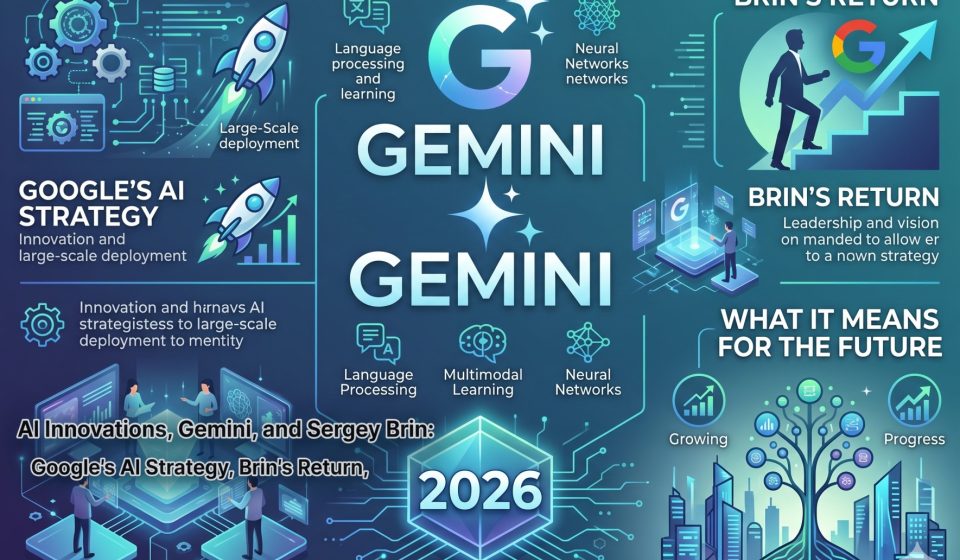
AI Innovations, Gemini, and Sergey Brin: Google’s AI Strategy, Brin’s Return, and What It Means for the Future of Gemini in 2026

Google’s Gemini AI program sits at the center of one of the most consequential technology competitions of the decade. At the same time, the story behind Gemini’s accelerated development involves a remarkable chapter in Silicon Valley history: the return of Google co-founder Sergey Brin to active technical work at a company he helped build, drawn back into the trenches by the rise of generative AI. Understanding the AI innovations shaping Gemini in 2026 requires understanding both the technical advances themselves and the organizational context in which they emerged.
Sergey Brin’s Return to Google and What It Signals
Sergey Brin formally stepped back from day-to-day involvement at Google in 2019 when Alphabet restructured and he and Larry Page relinquished their executive roles. For several years, Brin focused on personal projects, including his LTA Research airship venture. Then, in late 2022 and through 2023, reporting emerged confirming that Brin had returned to Google’s AI labs on a hands-on basis, attending meetings, reviewing code, and contributing to Gemini’s development.
Brin’s return was widely interpreted as a signal of how seriously Google’s leadership viewed the competitive threat posed by OpenAI’s ChatGPT. The initial launch of ChatGPT in November 2022 and the rapid adoption that followed reportedly triggered what Google internally described as a “code red” situation, prompting an all-hands mobilization of resources toward generative AI products. For a co-founder of Brin’s stature to re-engage personally with technical work was a meaningful indicator of the urgency that Google’s leadership felt.
By 2024 and into 2025, Brin was publicly described as being heavily involved with Gemini, and in interviews he spoke candidly about his excitement for the technology and his belief that AI represented the most significant technological development in his career. His return brought both symbolic weight and substantive technical input to a product that needed to accelerate rapidly to close the gap with OpenAI.
Google DeepMind and the Organizational Structure Behind Gemini
One of the most significant structural decisions Google made in response to the AI competitive landscape was the merger of Google Brain and DeepMind into a single organization, Google DeepMind, announced in April 2023. This brought together two world-class research labs that had previously operated somewhat independently, consolidating talent, compute resources, and research agendas under a unified leadership structure headed by DeepMind founder Demis Hassabis.
The Gemini model family is the primary product of this merged organization. Gemini represents Google DeepMind’s attempt to build a multimodal AI system that is competitive with OpenAI’s GPT-4 and GPT-4o families while leveraging Google’s unique assets, particularly its search index, its YouTube video corpus, its Google Workspace user base, and its world-class infrastructure through Google Cloud.
This organizational structure means that Gemini benefits from research advances across a broader range of AI disciplines than most competing models. DeepMind’s expertise in reinforcement learning, protein structure prediction through AlphaFold, game-playing systems like AlphaGo and Gemini-linked Alphacode, and fundamental AI safety research all feed into the broader technical foundation from which Gemini is developed.
Key Technical Innovations in Gemini Through 2025 and 2026
Multimodal Architecture from the Ground Up
One of the most significant architectural distinctions of Gemini relative to earlier large language models is that it was designed as a natively multimodal system from the start, rather than having multimodal capabilities bolted on after the fact. Gemini can process and reason across text, images, audio, video, and code within a single model, not through separate specialized modules. This architecture enables a different class of reasoning tasks, particularly those that involve understanding relationships between different types of information simultaneously.
In practice, this means a user can show Gemini a photograph and a text description of a related problem and ask it to reason across both inputs in a unified way. Or a developer can ask Gemini to analyze a video and provide timestamped explanations of what is happening at each key moment. These capabilities were available in limited forms with earlier models but have become substantially more capable through Gemini 1.5 and the 2.0 generation.
The 1 Million Token Context Window
Perhaps the most practically significant capability advance in Gemini 1.5 was the introduction of a 1 million token context window, which was later expanded in research settings to 2 million tokens. To put this in concrete terms, a 1 million token context window can hold approximately 750,000 words, which is equivalent to several large novels, or an entire mid-size codebase, or hundreds of research papers, all within a single conversation session.
This context window capability directly addresses a major limitation of earlier AI systems, which struggled to maintain coherent understanding across long documents or extended conversations. Gemini 1.5 Pro’s long context capability was one of the technical differentiators that Google highlighted as a meaningful advance beyond competing models, and it has practical significance for users working with large codebases, lengthy legal documents, or extended research projects.
For users who want to move long conversations from Gemini to another platform while preserving full context, the guide on loading a long Gemini conversation into Claude explains the options and tools available for that kind of migration.
Gemini 2.0 Flash and the Inference Efficiency Focus
The Gemini 2.0 generation, announced at the end of 2024 and expanded through 2025, introduced a stronger focus on inference efficiency alongside raw capability. Gemini 2.0 Flash is designed to deliver capable AI responses at significantly lower latency and cost than the Pro tier, making it practical to integrate Gemini into applications and workflows where response speed and API cost are critical constraints.
This pattern, of developing both a premium capability tier and a fast, efficient tier, mirrors the strategy that OpenAI has used with GPT-4 and GPT-4o Mini. The availability of capable, low-cost inference tiers is what enables AI to move from a specialized professional tool into a broadly embedded capability across consumer products, mobile apps, and enterprise software.
Gemini Integration Across the Google Product Ecosystem
One of the structural advantages that Google has in the AI competition is the breadth of its existing product ecosystem. Gemini is not just a chat interface; it is being embedded into Gmail, Google Docs, Google Sheets, Google Slides, Google Meet, Android devices, Pixel phones, Google Search, Google Maps, and YouTube. The scale of this integration means that Gemini’s effective reach extends to billions of users who may encounter it within products they already use daily, even if they never visit gemini.google.com directly.
This integration strategy is central to Google’s competitive positioning. While OpenAI’s ChatGPT has larger direct mindshare and Microsoft’s Copilot has deep Office integration, Google’s ecosystem is broader and more consumer-facing. Sergey Brin and other Google leaders have pointed to this ecosystem breadth as a durable competitive advantage that pure-play AI companies cannot easily replicate.
Sergey Brin’s Stated Views on AI Development and Safety
In various interviews from 2023 through 2025, Brin has spoken about his personal views on AI development and where he sees the technology heading. He has expressed strong excitement about the pace of progress while also acknowledging that the speed of development creates safety challenges that require serious attention.
Brin has described generative AI as a technology that is advancing faster than any previous technology he has witnessed, including the early days of the web and the emergence of mobile computing. He has noted that this pace creates both opportunity and responsibility, and that the organizations developing frontier models carry an obligation to think carefully about how the technology is deployed and what safeguards are in place.
On the competitive dimension, Brin has been candid that the emergence of OpenAI’s public products accelerated Google’s own development timeline and that the competitive dynamic has been productive in pushing all participants to move faster and invest more. He has positioned the current period as one of the most consequential in the history of computing.
Google’s AI Innovations in the Context of Broader Industry Competition
The AI competitive landscape in 2026 features multiple well-capitalized organizations pushing the frontier simultaneously. OpenAI, Google DeepMind, Anthropic, Meta AI, and a growing number of smaller model developers are all releasing capable models on increasingly short release cycles. For users, this competition is largely positive: it drives rapid capability improvements, keeps pricing competitive, and accelerates the development of features that users actually want.
For Gemini specifically, the competitive pressure has resulted in a faster development cadence than Google’s historical product release patterns would have suggested. The Gemini product that exists in 2026 is significantly more capable than what Google could credibly offer in 2022, and the gap between Gemini and leading competitors has narrowed considerably.
The implications for users are practical. If you built a workflow around one AI platform based on capability comparisons from 2023, that comparison may have changed substantially. The guide on whether Gemini is better than ChatGPT in 2026 provides an up-to-date capability comparison that reflects the current state of both platforms.
What Google AI Innovations Mean for Users Who Switch Platforms
The rapid pace of AI development has created a pattern where users migrate between platforms as capability and pricing evolve. Someone who chose ChatGPT in 2022 might be evaluating Gemini now based on its long context capabilities and Google Workspace integration. Someone who has been on Gemini might be looking at Claude for its Constitutional AI safety approach and strong performance in nuanced reasoning tasks.
This platform mobility is increasingly supported by tools that preserve the conversation history and context that users build up during their time with one platform. TransferLLM’s suite of tools addresses exactly this need. Users who want to move from ChatGPT to Gemini can transfer their conversation history locally without manual copy-pasting or reformatting. Users making the opposite move, from Gemini to Claude, can use gemini2claude.com for a direct, locally-processed transfer that keeps full conversation structure and context intact. And users shifting from ChatGPT to Claude can use chatgpt2claude.com for the same seamless migration.
The ability to migrate conversation history has become more important as users accumulate months or years of AI-assisted work in a single platform and face the decision of whether the switching cost is worth the capability gain on another platform. With local transfer tools, that switching cost is significantly reduced.
For users who have tried and struggled with transferring long ChatGPT conversations to Claude, the detailed migration guide covers common issues and how to resolve them.
Project Astra and the Future of Gemini as an Agentic System
One of the most forward-looking demonstrations associated with Gemini and Google DeepMind is Project Astra, unveiled at Google I/O 2024 and expanded in subsequent demonstrations. Project Astra represents a vision of Gemini as a real-time multimodal AI agent that can see what a user’s camera sees, hear what their microphone hears, and respond in real time to help with tasks in the physical world.
In demonstrations, Astra identified objects in a room, recalled where a pair of glasses was placed minutes earlier, answered questions about code visible on a screen, and provided real-time guidance through audio responses. The demonstrations were run on both desktop and mobile form factors, with a version designed to work within smart glasses highlighted as a direction for future consumer hardware.
The broader vision here is of Gemini as a persistent AI system that is aware of context across the user’s digital and physical environment, not just within a chat interface. If this vision is realized at scale, it would represent a fundamental shift in how AI assistants are used, from a tool you open when you have a task to a persistent presence that is continuously available.
Google’s Gemini glasses and Project Astra developments in 2026 are covered in more detail in the dedicated guide on wearable AI.
Google AI Studio and Developer Access to Gemini’s Capabilities
For developers and technical users, Google AI Studio provides direct API access to Gemini models, including the ability to experiment with different model tiers, context lengths, and modality combinations. Google AI Studio is free to use within rate limits and provides a no-code interface for testing prompts before integrating them into applications.
The Gemini API available through Google AI Studio and Google Cloud Vertex AI gives developers access to the same underlying models that power the consumer Gemini app, with additional control over parameters like temperature, output format, system instructions, and safety settings. This has made Gemini a competitive option for enterprise AI application development alongside OpenAI’s API and Anthropic’s Claude API.
For users wondering about the difference between Google AI Studio and the consumer Gemini app, the guide on Google AI Studio vs Gemini explains the practical distinctions and which interface is appropriate for which use case.
The Broader Legacy of Brin’s Re-engagement with AI
Sergey Brin’s return to active technical involvement at Google during the AI inflection point carries significance beyond one company’s competitive positioning. It reflects a pattern where the deepest technological shifts draw back the people who have the most institutional knowledge, the most long-term perspective, and the most personal stake in ensuring that the technology develops well.
Brin has described the current AI moment as potentially more significant than the original birth of the web, a statement he is qualified to make given his role in building the search technology that shaped the web era. Whether that assessment proves accurate will depend on how AI capabilities develop and how the societal integration of these systems is managed over the next decade.
What is clear in 2026 is that Gemini, as the primary product of the Google DeepMind organization that Brin has helped guide, is a genuinely capable AI system that competes at the frontier level. It is not the clear leader in every capability dimension, but it is a serious system with distinctive advantages in multimodal reasoning, long context handling, Google ecosystem integration, and the ability to draw from Google’s uniquely comprehensive view of the web.
Frequently Asked Questions
Q1: Why did Sergey Brin return to Google to work on Gemini AI?
Brin returned to active technical involvement at Google in response to the rapid rise of generative AI, which he and other Google leaders saw as a defining technological moment. The public launch of ChatGPT in late 2022 and its rapid adoption created internal urgency at Google, and Brin re-engaged with technical work on what became the Gemini program. He has described the current AI period as the most significant technological development he has witnessed in his career.
Q2: What makes Gemini technically different from other large language models like ChatGPT?
Gemini was designed as a natively multimodal system from the start, capable of processing text, images, audio, video, and code within a single model rather than through separate specialized modules. Its 1 million token context window is significantly larger than many competing models, and its integration with Google’s search index and product ecosystem gives it a different retrieval and grounding profile compared to models built by organizations without a comparable web infrastructure.
Q3: What is Project Astra and how does it relate to Gemini?
Project Astra is Google DeepMind’s research demonstration of Gemini as a real-time agentic assistant capable of seeing through a device camera, hearing through a microphone, and responding to the user’s immediate physical and digital environment. It represents a vision of Gemini as a persistent, always-available AI assistant rather than a tool you invoke for specific tasks.
Q4: If I have been building workflows in Gemini and want to switch to Claude, can I bring my conversation history with me?
Yes. The gemini2claude.com transfer tool allows you to migrate your Gemini conversation history directly to Claude, with all message structure, formatting, and context preserved. The process runs entirely on your local device, so your conversations are never routed through any third-party server. Similarly, users moving between ChatGPT and Gemini can use chatgpt2gemini.com for a locally-processed transfer.
Q5: How does Google’s broader AI strategy affect which Gemini features are prioritized?
Google’s AI strategy is shaped by the need to compete with OpenAI across multiple product categories simultaneously while also protecting its core search advertising business from AI-driven disruption. This means Gemini development is influenced by both the need to achieve frontier capability parity with GPT-4o and the need to integrate AI into Google’s existing product suite in ways that preserve user engagement. The result is a development roadmap that balances raw capability advances with ecosystem integration features, which is why Gemini’s Workspace and Search integrations have received as much investment as its core model capabilities.Share